Showing posts with label thesis inquiry. Show all posts

12.29.2009

Thesis finding on art journaling for self-care

Well I defended the thesis and officially graduated!! So I thought I would share some basics of my findings about art journaling here!

Here are the themes that I found:
  • The journal (or book) itself
  • Process of journaling
  • Routine of journaling
  • Content within the journals
  • Imagery within the journals
  • Need for self-care
The journal for me was such an essential part of the process. This is one of my favorite excerpts:
One of the first themes that emerged in the initial phases of the research was the importance of the journal itself. The book that held the journal became an essential part of the art journaling process for the researcher, and became a large focus as to what made art journaling different from art making. The journal became a container for emotionally-charged material, and created a defined boundary on each page and within the book itself. While the therapist can be seen as the container within the therapy session, the journal became the container for the therapist, offering a holding environment for the therapist’s emotional reaction to the client material. There is almost a double boundary within the journal, there is a container that is created with the edge of the pages, and a container that is created by the book. Although the emotions could be contained on a sheet of paper, this could leave them vulnerable to the world. The ability to close the journal gives the therapist the ability to contain the emotions and content on another level.
Additionally, the rhythm of opening and closing the journal can be seen as a metaphor for the therapist transitioning between different roles of the self. The therapist opens the journal, exposing the vulnerability and emotion inside. With the pages open, the therapist can change roles to a more vulnerable role that allows herself to truly feel the emotions of the day and put them on the paper. This more vulnerable role is then able to openly express all the emotions, whether positive, negative or appropriate without judgment. With this vulnerability poured onto the page, the act of closing the journal can again allow for a final role change, one that allows the therapist to transition to the next phase whether it is that of a student, mother, wife or other role.
I would love to post the whole thesis, but it would be way too much on here. Feel free to email me though, and I would happily send it to you!

5.22.2009

Big News

I just received an email telling me that my AATA (American Art Therapy Association) proposal had been accepted and I will be presenting at the 2009 National Art Therapy Conference in Dallas!! Woo hoo... Texas here I come!

4.23.2009

Audience

I have been trying to think about the audience for my art journals recently. I make them for myself, but share them with the world via this blog... Why? And what does that mean?

I think for me, my intention is to make the art journals for myself, and to communicate what I need to through the art and writing. The reason I share them is two-fold: I hope that it inspires others to keep journals (art or not) and I can create my own artist studio (or community) through the blog.

One of the things that I have been thinking about is creativity and the creative process, and being in a studio and having other artists around me feeds my creativity. I can recreate this through the cyber world, through my blogs and other's, by visiting and posting and creating a dialog. That is where sharing with the world on the blogs come in.

However, I am also able to keep some secrecy to my journals, because a lot of the communication is through the artwork, and I do not at this point explain the art on the blog. It is up for interpretation.

In addition, I hope to share my process at the National Art Therapy Conference in November, and will probably do so at other presentations and workshops of smaller scale. Next week, in fact, I am showing my journals at the Student Art Therapy Association's annual art show, Art of Awareness.

4.09.2009

Why do I journal

I have been thinking a lot lately about why I keep an art journal. Now mind you this is a fairly new practice for me, but one that has influenced many parts of my life—for instance, I am writing my thesis on art journaling as self-care for the therapist and I have begun a weekly journaling night with my boyfriend. (On a side note he told me this week that he is glad that we have art journal night--so cute!) So why art journaling?

The abstract for my presentation yesterday said:
Art journaling combines the written language and the visual language to give a greater breadth of expression and understanding. The researcher specifically used art journaling as a means of self-care while at practicum sites, allowing the researcher to purge emotional content related to clients and site work. Being attuned to the needs of the self can allow the therapist to be greater attuned to the client in sessions, therefore being more competent as a therapist.
With some of the discussions that I was having during my presentation, I was able to verbalize something that I had been thinking for a while. By keeping the art journal you are externalizing, rather than internalizing, the experiences of the clients. With the idea of vicarious traumatization, or basically PTSD symptoms from being exposed to someone else's trauma, being able to make the distinction between the client's trauma and your own life is important. Therefor it could minimize the negative effects while still allowing for the positive effects.

Furthermore, I was able to talk about the metaphor of the book as a container or a boundary. The book, more specifically, the journal becomes an external container for images, thoughts and feelings that are otherwise at risk of being internalized. These images are then contained in an area separate from you - and the book somehow creates safety, both for the images and for the journaler.

Journaling also becomes a routine, or a habit. And for me, being a habit, it is harder for me to put it off. It becomes part of who I am. And because it is a routine, it also becomes a record, or some sort of memoir of that period in my life.

And lastly, the size of the journal is manageable. It is not a huge blank canvas in front of me, yet the sum of all the pages is just as great. But being broken down in this manageable size, it quite literally can be carried with me.

Those are all the reasons that I can think of for now... but I know that there are more.

4.08.2009

Graduate Symposium

Today I presented my research on art journaling as self-care for the therapist at the graduate symposium at my school. Although it was a good experience, most of the other presentations were on much more scientific endeavors, and it was hard at times to relate my work to theirs.

4.02.2009

Theory of Creativity

When asked what my theory of creativity is, this is what I wrote:

What is my theory of creativity? A person process—the process, not the product. Unique—different for everyone. For me it is getting in, digging in, getting dirty. Access to lots of materials, and able to just create. Either with intention, or not. And being able to accept that the product in not what makes value of the process.
Sometimes creativity can be felt. It is palpable. In the room, in the studio. Creativity can be created—by atmosphere, people and materials.

When my classmates and I were discussing our different theories, one of the lines that I identified with was "you come out of auto-pilot, you begin to experience." I think that is part of what I was trying to explain, the experience and the energy that is created by being creative.

2.26.2009

Diary vs. Journal

A classmate asked the other day about the difference between a diary and a journal, and I recently found this great post by quinncreative giving a great explanation.
“What’s the difference between a journal and a diary?" A diary is a report of what happened during the day—where you ate, who you met, the details leading up to the kerfluffle in the office, and who took whose side. It’s a bit like a newspaper about you.

A journal is completely different. A journal is about examining your life. It’s a GPS system for your spirit. “I’ve made this mistake before. . . and I always make it when I rushed for time and feel panicky. But I feel panicky because I know I’m headed for the same mistake.” Journals lead to insight, growth, and sometimes, achieving a goal.

2.13.2009

Art Journaling as a Way of Life

I have been thinking a lot lately about some comments that I received about how many art journals I have going at the same time—the organization that this takes and how it must be confusing. I have never thought of it this way. Each journal has a story to tell. Each one is different, has a different purpose. They tell a piece of my story.

My sketch journal is small and compact. I keep it i my purse and sketch my life when I have a moment. Something small from the day. A cup of tea, a bar of soap. But it tells my story, something that struck me that day as beautiful, or on my mind. They are not necessarily artistically correct, but they are about more than the aesthetics.

My thesis journal, chronicles my art therapy practicum placement. The issues that I would normally take home and dwell on in my personal life, have a home in this journal. I work them out on the pages, close the book, and can go on with my personal life, without having to bring home the stress of the day.

I have a journal that I will be starting with my fella. We are moving in together, and I want to chronicle the first year of our life together. We are going to use a deck of cards, and work on one a week for 52 weeks. This is our story.

And I have many other ones that don't necessarily have a theme. Or are blank for the moment until they are called upon to be used. Art journaling has become more than just a hobby, but it has become a way of life for me. A way to record my life, to reflect on it, and to destress from it.

2.09.2009

Loose Pages vs Bound Collective

So I was thumbing through Wide Open's notecards by Randi Fueherhelm-Watts yesterday and found an answer to why I questioned the loose pages as a journal. It says:
Why journal in a book? Why not loose pages? It is kind of like your life. Waking up every morning, we have to go back to it just the way it was left the night before—being forced to look at mistakes, successes, hopes, hurts—and go on to the next page. Even when we don't want to. Even when we just want to go out and buy a new book.
We keep going. Hauling it around like a bag of rocks and wondering what in the world we were thinking—buying a book this size or jumping into that relationship or taking that job too quickly. It all comes out the same. The bottom line is, we all have to get up the next day and face it.
Loose pages can be shuffled, tossed, crumbled, prearranged...its hard for them to represent something substantial. Often they end up as preconcieved, acceptable pages saying all the right things, written for others to see and smile and tell you how wonderful you are.
Loose journal pages aren't heavy and can simply be tucked into whatever you are carrying. They can also easily be blown out of you hand in a moment.
A book has substance. Concise pages bound together so tightly, they, like your daily event, make you who you are.

So I think that is what I was thinking about when I was questioning as well. Although I had not conceptualized the answer yet. I am not by any means saying that it is unacceptable to journal on loose pages, just found reasoning to support the thoughts I was thinking for myself.

1.30.2009

Questions

There are many questions that I have still unanswered after today's documentation review.
  1. Who is the documentation for?
  2. Who is the viewer/audience?
  3. What aspects of the thesis journal need to be shared/made public?
At some points I felt like there were more questions than there were answers. I am still not sure how I feel about all of the questions, and I guess that is part of the inquiry.

At the basic root of the question is the idea of a journal. The word journal was derived from the Old French word journee which can be translated as ‘day’ (Diehn, 2002). Thus, a journal referred to a book in which one would record a day’s events. Art journal then is a journal that uses both written and visual expression opening up “new processes of thinking, feeling, observing, focusing, and experiencing life” (Diehn, 2002, p. 8). A journal has also referred to public records including newspapers, and are not necessarily considered private, as is a diary. So with this understanding, I feel that a journal can be more public, even though I create the pages for myself, others may find value or appreciation in them. It is as Tessa commented in class that she has rarely known something to have been a completely unique and individual experience, in this way I share my experience, in my words---and art.

Diehn, G. (2002). The decorated page: Journals, scrapbooks & albums made simply beautiful. New York: Lark Books.

1.13.2009

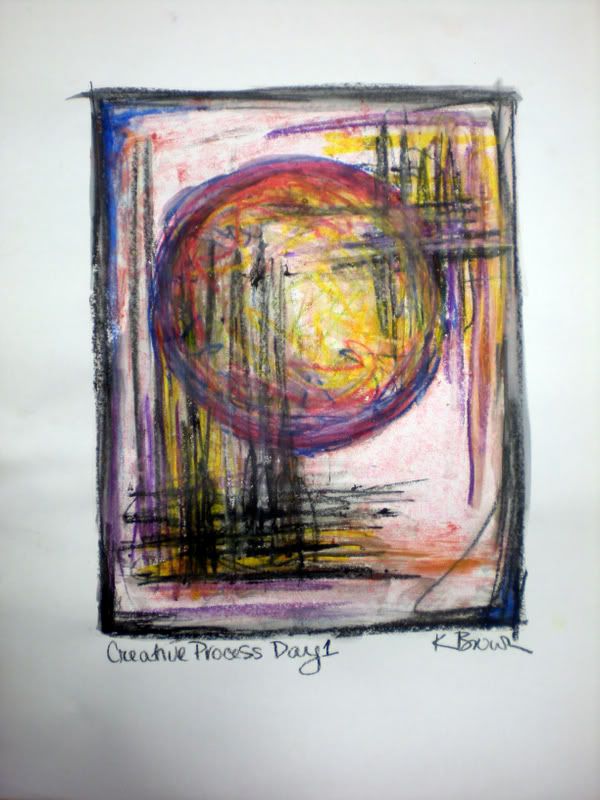
Day 1

Here is a piece that I did in the first day of Creative Process. I wanted to use printmaking, but did not have all the materials I needed so the print came out light. I then used water-soluble oil pastel over top of it. It turned out ok. Not what I wanted but it was nice to create.


For this class we are supposed to come up with a topic to concentrate on. Since art journaling aligns with my thesis I am going to do a sort of altered book art journal in addition to the art journal I am keeping for practicum. I am excited about it.
Related Posts Plugin for WordPress, Blogger...